
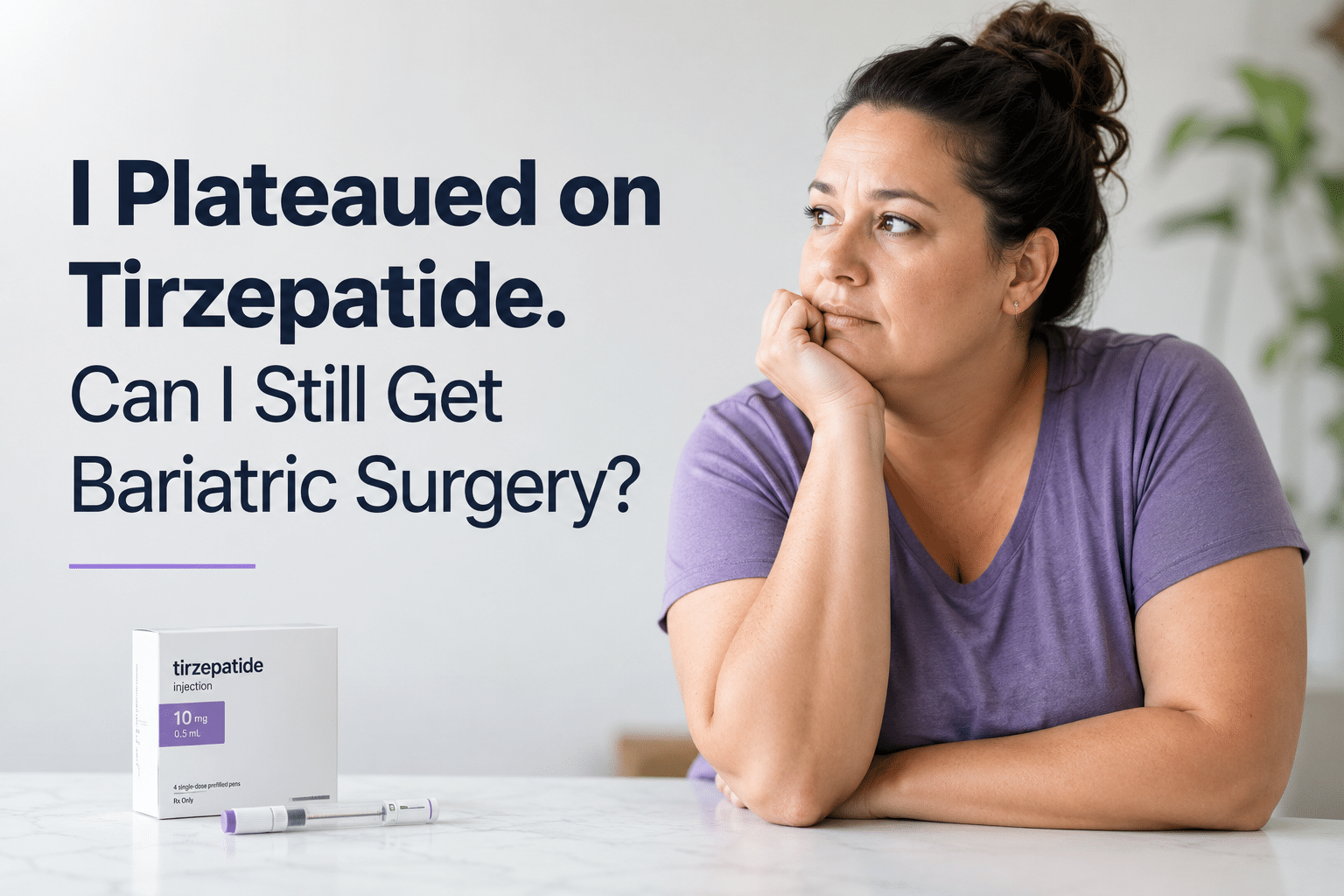
Yes. If you stalled on a GLP-1, maxed out your dose, or you simply cannot keep paying for it, you are still a surgical candidate. And I am going to tell you something most people find hard to believe when they first sit across from me: you may be a better candidate now than you were before you ever started the medication.
I want to clear one thing out of the way before we go any further, because it is the thing quietly stopping most of you from picking up the phone. You did not fail. Reaching a plateau on tirzepatide or semaglutide is not a character flaw, a discipline problem, or proof that you were doing it wrong. It is biology behaving exactly the way it was built to. Once you understand that, the decision in front of you looks very different, and a lot less heavy.
I have performed more than 7,800 bariatric procedures at VIDA Wellness and Beauty Center in Tijuana, fifteen minutes from the San Diego border. A large and growing share of the patients I operate on now walked in the same way you might: they tried a GLP-1 first, it worked for a while, and then it stopped, or the cost stopped making sense. So let me walk you through your case the way I would if you were sitting in my office.
Why a plateau is not your fault, and why that matters
Your body defends a weight the way a thermostat defends a temperature. Scientists call it your set point. When you lose weight, your brain reads it as a threat and pushes back: it raises your hunger signals, quiets your fullness signals, and lowers the number of calories you burn at rest. This is not weakness. It is a survival system that kept your ancestors alive through famine, and it does not know the difference between a famine and a diet.
I did my PhD in molecular biology and genetics, so I will say this plainly: obesity is a hormonal and neurological disease, not a moral one. Researchers at Yale describe the brain’s defended weight as an “Enough Point,” set and guarded by nutrient-stimulated hormones, the same GLP-1 and GIP signals your medication targets. As they put it, it is not a matter of choice, willpower, or moral failing. It is a chronic disease like any other. In late 2025 the World Health Organization formally recognized obesity as exactly that, a chronic, relapsing disease.
A GLP-1 works by borrowing those hormone signals to lower your Enough Point for a while. It is a genuinely good tool. But your biology adapts to the dose, and eventually the same amount of medication only holds the line instead of moving it. That is a plateau. It is common, it usually shows up somewhere around six to twelve months, and it does not mean the drug broke or that you did. It means you reached the edge of what that tool can do for your particular biology.
Here is why I am spending time on this instead of jumping to the pitch: patients who believe their plateau is a personal failure tend to make one of two bad decisions. They either white-knuckle it and blame themselves, or they quietly quit the medication and hope for the best. Both usually end in regain. The better move is to stop grading yourself and start asking a colder, more useful question: what is the most durable tool available to me now?
Should I switch from a GLP-1 to surgery? A quick decision guide
| Your situation | What it usually means | What I recommend |
|---|---|---|
| You hit your maximum dose and the scale stopped moving | You reached the ceiling of what the drug can do for your biology | Surgery is a reasonable next step, not a failure |
| You lost weight but cannot afford the medication long term | The drug works, the cost model does not | Surgery is a one-time procedure instead of an indefinite bill |
| The nausea, vomiting, or fatigue is intolerable | Your body is not tolerating the class well | Surgery works through a different mechanism you may tolerate better |
| You want the result to last without a weekly injection forever | You are looking for durability | Surgery is the most durable treatment we have for severe obesity |
| Your BMI is 35 or higher, or 30 or higher with a condition like diabetes | You meet standard surgical criteria | You qualify. Let us evaluate you |
| Your BMI is under 27 | You are below the surgical threshold | Stay medical for now. Surgery is not the right tool yet |
If more than one of these rows sounds like you, that is your signal to at least get evaluated. It does not commit you to anything, and I will tell you honestly if you are not a candidate.
What actually happens if I just stop the medication?
Most people regain most of the weight. I am going to give you the trial data straight, because you deserve numbers instead of reassurance, and because the numbers are the whole argument.
In the STEP-1 extension study of semaglutide, patients who stopped the drug regained about two-thirds of the weight they had lost within one year, and the improvements in blood pressure, blood sugar, and cholesterol drifted back toward where they started (Wilding et al., 2022). The follow-up STEP-4 trial showed the same pattern: within roughly a year of stopping semaglutide, participants regained about two-thirds of their loss, while the patients who stayed on the drug kept losing.
Tirzepatide is not different. In the SURMOUNT-4 trial, patients first lost around 21% of their body weight, then half were switched to placebo. By the end of the study, 82.5% of the people who stopped had regained at least a quarter of everything they had lost, and the cardiometabolic gains reversed right alongside the weight (Aronne et al., JAMA 2024; Horn et al., JAMA Internal Medicine, 2025). A 2026 systematic review led by Susan West found the same thing across the literature, with the regain arriving within about 18 months and the metabolic benefits unwinding in parallel.
I want to be precise about what this data means and what it does not. It does not mean you are doomed if you stop. It means that stopping without a plan is a losing bet, because your set point is still sitting there, waiting. As a recent meta-analysis put it, weight regain after stopping is not a treatment failure, it is a predictable biological response. Which brings us back to the real question. If your biology is going to keep defending that old weight, what changes the defended weight itself?
Is surgery actually better than staying on the drug, or is that just what a surgeon would say?
Fair question. So let me answer it with 2026 data instead of my opinion, including studies I had nothing to do with.
At the American Society for Metabolic and Bariatric Surgery annual meeting in May 2026, a team led by Dr. John Morton at Yale presented one of the largest comparisons ever done: a systematic review of 30 studies covering 433,465 patients, split between surgery and GLP-1 therapy. At twelve months, surgery produced total weight loss more than 20 percentage points higher than GLP-1 medications. For type 2 diabetes, surgery delivered a 42.2% higher remission rate. Remission of high blood pressure and high cholesterol was substantially higher with surgery too. Morton’s own summary was that GLP-1 medications are an important advance but do not match the magnitude or durability of surgery, which remains one of the most underused treatments in medicine.
Durability is the word I want you to hold onto. My signature procedure, the Enhanced Gastric Sleeve, produces 56% to 60% of excess weight loss across those 7,800-plus cases I have performed, at a complication rate of 0.020%. Gastric bypass, which I reserve for patients with severe diabetes or significant reflux, produces around 80% excess weight loss. Sleeve gastrectomy has been shown to cut HbA1c by about 2.5% and put roughly 40% of type 2 diabetes patients into remission at five years. Those results do not vanish the week you skip a dose, because the operation changes your anatomy and your gut hormone signaling in a way an injection cannot.
None of this makes the medication bad. It makes it a different category of tool. A GLP-1 manages the disease while you take it. Surgery treats it in a way that holds.
Doesn’t my GLP-1 history make surgery less effective?
No. This is the single most common fear I hear, and the 2026 data puts it to rest cleanly.
Researchers at NYU Grossman School of Medicine studied more than 6,700 patients who were on semaglutide or tirzepatide in the six months before their operation, and compared them against roughly 127,000 patients who went to surgery with no prior GLP-1 use, drawn from records spanning 2019 to 2025 (Kozato and Chhabra, ASMBS 2026, Abstract 4149). The patients lost about 8% of their body weight on the medication first. Then they had surgery, and total weight loss climbed to more than 25% for gastric bypass and about 20% for sleeve. The patients who skipped the drug and went straight to surgery lost only 2% to 3% more overall.
Read that again, because it is the whole point. The medication did not blunt the surgery. It gave you a head start, and the operation still delivered its full effect on top. Lead author Dr. Karan Chhabra put it simply: metabolic and bariatric surgery continues to deliver substantial and durable weight loss in this population. Your months on tirzepatide are not a liability I have to work around. They are progress you already banked.
But is surgery drastic, or dangerous?
I understand why the word “surgery” sounds heavier than “injection.” Let me give you the actual risk picture rather than the emotional one.
Modern bariatric surgery has a safety profile comparable to some of the most common operations performed in the United States, including gallbladder removal, appendectomy, and knee replacement. That is not a marketing line, it is how the field’s own governing body describes it. In my own practice, across more than 7,800 procedures, the complication rate is 0.020%. My Enhanced Gastric Sleeve is drain-free, uses a double-buttress reinforcement of the staple line to protect against leaks, and includes a preemptive pain protocol so recovery is far more comfortable than the horror stories you may have read.
Compare that to the risks you are already carrying. Severe obesity itself raises your risk of type 2 diabetes, heart disease, stroke, and several cancers every year you live with it. The genuinely risky option is often not surgery. It is another two or three years of a defended high weight while you wait to see whether the next medication sticks.
Do I have to stop my GLP-1 before surgery, and is that complicated?
Yes to the first, no to the second, because managing it is my job, not yours.
GLP-1s slow how fast your stomach empties. That is part of how they curb appetite, but under general anesthesia a stomach that still holds food raises the risk of aspiration. I follow the multi-society guidance issued by the American Society of Anesthesiologists and its partner organizations in October 2024. For a weekly medication like semaglutide or tirzepatide, that generally means holding one weekly dose before your procedure. For higher-risk patients I add a liquid-only diet for 24 hours beforehand, adjust the anesthetic plan, and use point-of-care ultrasound to confirm the stomach is empty right before we begin.
You do not need to solve this or guess at timing off a blog post. When you book, my team builds the exact stop-and-restart plan around your specific drug, your dose, and your surgery date. This is a solved problem in experienced hands.
Will I lose muscle, and does surgery make that worse?
Muscle loss is a real concern with any rapid weight loss, and this is an area where surgery done properly protects you better than an unmonitored medication does.
High-dose GLP-1 therapy can pull a meaningful share of total weight loss from lean mass. Data presented at the 2026 American Diabetes Association meetings put that figure anywhere from roughly a quarter to more than 40% of the weight lost, with older patients and women most vulnerable to sarcopenia. But notice the real culprit: it is rarely the tool itself. It is losing weight quickly with no protein strategy and no resistance training, often on a prescription mailed from a website with no follow-up attached.
My post-operative protocol is built around exactly that gap. Structured protein targets, early mobility, and a defined follow-up schedule are not optional extras in my practice, they are the design. Protecting your muscle while you lose fat is a supervised process, and it is one of the main reasons I insist on real aftercare instead of handing you a result and waving goodbye. Done this way, surgery is a muscle-protection strategy, not a threat to it.
Can I still use a GLP-1 after surgery if I need one?
Yes, and some patients do. This is not a door you close forever by choosing surgery. If anything, surgery gives you more options, not fewer.
The same NYU data is useful here. Among patients who had used a GLP-1 before surgery, a portion resumed one afterward, more often after sleeve than bypass in the first year (57.4% versus 44.1%), and by three years about two-thirds were on a medication again. There is even good news for your blood sugar in that: a 2026 study presented at ENDO found that patients who add a GLP-1 in the first year after surgery reached lower HbA1c and higher diabetes remission at 18 months. So if you and I decide later that a low maintenance dose helps you hold your result or fine-tune your metabolic numbers, that tool stays available.
But here is the flip side worth knowing. The NYU researchers found that patients who went straight to surgery, without the drug first, were less likely to need lifelong medication at all. Surgery can reduce your dependence on the injection, not just add to it. You get to decide, with data, instead of paying rent indefinitely by default.
Sleeve or bypass: which one is right for a patient like me?
That depends on your body and your conditions, and it is a conversation, not a formula. But here is how I think about it.
For most patients who plateaued on a GLP-1 and want durable weight loss with a lower-risk, faster-recovery operation, my Enhanced Gastric Sleeve is the workhorse. It removes 70% to 80% of the stomach, takes 45 to 60 minutes, and produces 56% to 60% excess weight loss. For patients with severe or long-standing type 2 diabetes, significant acid reflux, or a very high BMI, gastric bypass often wins, because it produces around 80% excess weight loss and tends to drive stronger, faster diabetes remission. If you have already had a sleeve and regained weight, revision options exist too, though I need your prior operative records first.
The point is that this is a tailored decision, and picking the right operation for your case is precisely what an evaluation is for.
What your life looks like on the other side
Picture the version of the next few years where you are not refilling a pen every week, not watching the price of your medication climb, and not lying awake wondering what happens to your body if the supply runs out or your coverage drops. Picture your diabetes in remission instead of managed. Picture a result that is still there in year three and year five, because the biology defending your old weight has actually changed.
That is not a fantasy I am selling you. It is the documented, durable outcome of the most effective treatment we have for severe obesity, in the hands of a surgeon who has done it 7,800 times. And it is a one-time procedure, at an all-inclusive price that is a fraction of the $15,000 to $25,000 these operations cost in the United States, covering the surgeon, operating room, anesthesia, labs, hospital, medications, transport, and a stay in our on-site Recovery Boutique Hotel.
What we still do not know
I hold myself to telling you where the evidence is honest and where it is not fully settled, because you should trust me on the hard parts, not just the flattering ones.
First, the real-world picture on stopping GLP-1s is a little less grim than the trials alone suggest. A Cleveland Clinic analysis of nearly 8,000 patients, published in March 2026, found that about 45% kept the weight off at one year, largely because they restarted the medication or switched to another obesity treatment rather than stopping cold. That does not contradict the regain data. It explains it: people who do something after stopping do better than people who do nothing. Surgery is one of the most reliable somethings there is.
Second, the NYU study drew from a large health-records database, not a randomized trial. It tells us convincingly that prior GLP-1 use does not compromise surgical outcomes, but it cannot prove the medication improves them. The head start is real. The exact mechanism is still being studied.
Third, the perioperative hold guidance for GLP-1s is still evolving, and even a one-week hold does not empty every patient’s stomach completely, which is exactly why I rely on individualized assessment and ultrasound rather than a single blanket rule.
If you want certainty about your specific case, the honest answer is that it starts with an evaluation, not an article.
The bottom line
A plateau is not the end of your options, and it is not a verdict on you. It is the moment the smart question changes from “why isn’t the drug working anymore” to “what is the most durable tool I can reach now.” You did not fail. You met the ceiling of one tool, and there is a better one waiting, backed by some of the largest and clearest evidence in modern medicine.
If your BMI is 35 or higher, or 30 or higher with a condition like type 2 diabetes, and you are tired of paying rent on a result that disappears the moment you stop, let us evaluate you. It costs you nothing to find out whether you are a candidate, and it commits you to nothing. My coordinator Lucia handles the details, the financing questions, and the scheduling, and you can reach her directly at (619) 815-3359. Tell her you plateaued on your GLP-1 and want to know your options. That sentence is enough to start.
Sources
- Kozato A, Chhabra KR, et al. Bariatric Surgery Effectiveness After GLP-1 Agonist Weight Loss. Presented at ASMBS Annual Meeting 2026, Abstract 4149. Surgery for Obesity and Related Diseases (SOARD) supplement.
- Morton JM, et al. Comparative effectiveness of metabolic and bariatric surgery versus GLP-1 receptor agonists: systematic review of 30 studies (433,465 patients). Presented at ASMBS Annual Meeting 2026 (Yale School of Medicine, Coreva-Scientific, Vanderbilt University, UT Health San Antonio).
- Wilding JPH, et al. Weight regain and cardiometabolic effects after withdrawal of semaglutide: the STEP-1 trial extension. Diabetes, Obesity and Metabolism, 2022.
- Rubino D, et al. STEP-4: continued weekly semaglutide vs placebo on weight-loss maintenance. JAMA, 2021.
- Aronne LJ, et al. Continued treatment with tirzepatide for maintenance of weight reduction: the SURMOUNT-4 randomized clinical trial. JAMA, 2024. Horn DB, et al. Cardiometabolic parameter change by weight regain on tirzepatide withdrawal: post hoc analysis of SURMOUNT-4. JAMA Internal Medicine, 2025. doi:10.1001/jamainternmed.2025.6112.
- West S, Scragg J, Aveyard P, et al. Weight regain after cessation of medication for weight management: systematic review and meta-analysis. 2026.
- Gasoyan H, et al. Real-world obesity treatment use and weight change after GLP-1 discontinuation. Cleveland Clinic, published March 2026.
- American Society of Anesthesiologists, American Society for Metabolic and Bariatric Surgery, et al. Multi-society clinical practice guidance for perioperative management of patients on GLP-1 receptor agonists. October 2024.
- Strand M, Watanabe J. Post-operative GLP-1 RAs, HbA1c, and diabetes remission after bariatric surgery. Presented at ENDO 2026, Abstract ORF42-05.
- American Diabetes Association 2026 Scientific Sessions: lean body mass changes with GLP-1 receptor agonist therapy.
- Yale School of Medicine / Y-Weight: obesity as a chronic neurometabolic disease and the body-fat set point (“Enough Point”). 2026.