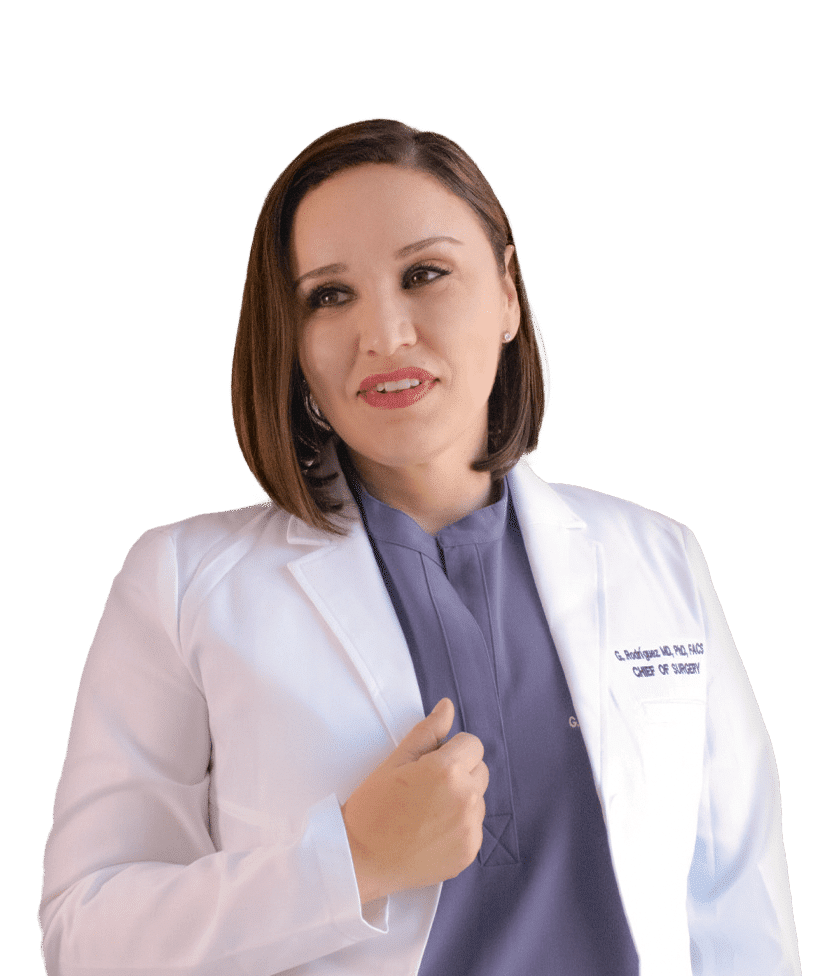

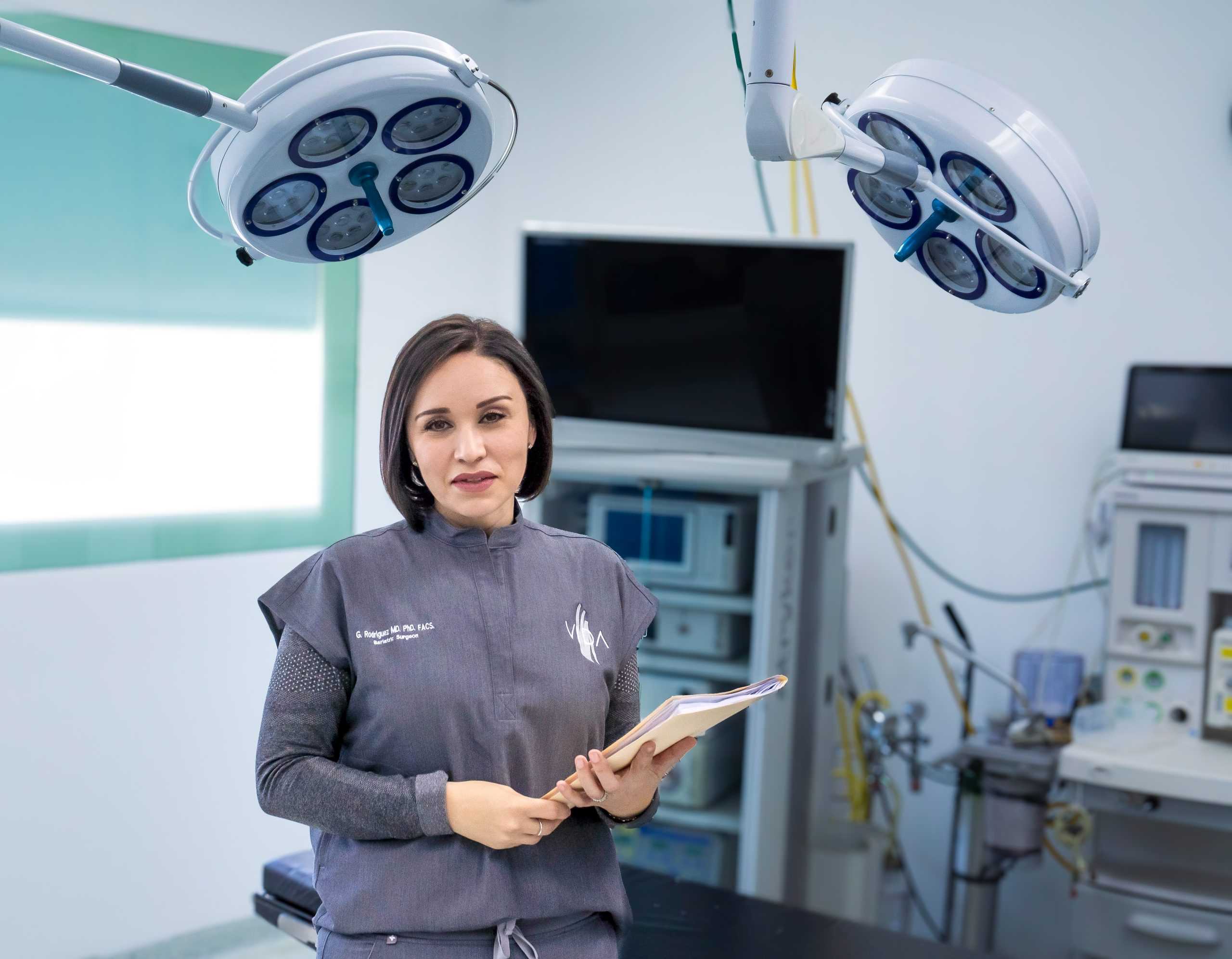
I am Dr. Gabriela Rodriguez Ruiz. I hold the Fellow of the American College of Surgeons (FACS) designation, I carry a PhD in Molecular Biology and Genetics from the University of Texas Health Science Center at Houston, and I have performed over 7,800 bariatric surgeries at VIDA Wellness and Beauty Center in Tijuana over the last 15 years. My gastric sleeve starts at $4,500 USD, all-inclusive.
That opening paragraph exists because I know exactly what brought you to this page. You typed something close to “safest FACS bariatric surgeon in Tijuana under $5,000” into a search bar, and now you are reading seven different websites trying to figure out who to trust with permanently altering your anatomy. I respect that. The decision you are making deserves direct answers, verifiable claims, and zero marketing fluff. So that is what this page will be.
Why does FACS matter when choosing a bariatric surgeon in Tijuana?
FACS stands for Fellow of the American College of Surgeons. The credential has existed since 1913. As of 2024, roughly 84,000 surgeons worldwide hold it (ACS, 2024). To earn it, a surgeon submits to peer review of their surgical competence, ethical standing, and professional qualifications. The review process mirrors the standards applied to surgeons practicing in California, Texas, or New York. The American College of Surgeons can revoke the designation for ethical violations, poor outcomes, or failure to maintain continuing education.
For a US patient crossing the border from San Diego, FACS answers a very specific fear: am I walking into a clinic that operates by the same accountability standards I would expect at home? The answer, for FACS-designated surgeons, is yes. The credential is not a membership you buy. You earn it, and you can lose it.
Several bariatric surgeons in Tijuana hold the FACS designation. Dr. Alejandro Gutierrez at Mexico Bariatric Center has it. Dr. Jalil Illan at Hospital BC has it. Dr. Ismael Cabrera at Stop Obesity has it. Dr. Victor Andrade has it. These are legitimate, credentialed surgeons. I am not going to sit here and tell you I am the only safe option in Tijuana. That would be dishonest and you would see through it immediately.
What I will tell you is what differentiates my practice from theirs. And I will give you the data to verify every claim yourself.
What makes my background different from other FACS surgeons in Tijuana?
Most bariatric surgeons follow a straightforward path: medical school, surgical residency, bariatric fellowship, clinical practice. I took a detour through molecular biology.
After finishing my medical degree at the Autonomous University of Baja California, I spent years at the University of Texas Health Science Center in Houston doing a PhD in Molecular Biology and Genetics at the Cardiovascular Investigation Center of the Brown Foundation Institute. I worked at Texas Medical Center rotating through Saint Luke’s Episcopal, Methodist, and Memorial Herman Hospital. My doctoral research focused on the genetic mechanisms behind cardiac hypertrophy, and I published in journals like Circulation, Critical Care & Shock, and Surgical Technology International.
Why does that matter for bariatric surgery?
Because obesity is a metabolic disease with genetic, hormonal, and inflammatory drivers. When I look at a patient with a BMI of 50 and type 2 diabetes, I am not thinking about the surgery in isolation. I am thinking about what happens at the cellular level when we remove 75% of the stomach: the ghrelin signaling changes, the GLP-1 response, the insulin sensitivity cascade, the inflammatory marker shifts. That lens shapes my surgical decisions in ways that clinical training alone would not provide.
It also informed my development of the Enhanced Bariatric Sleeve protocol, which I will explain in detail below. The protocol did not come from marketing brainstorming. It came from understanding the biology of why leaks happen and engineering a surgical approach to prevent them.
To my knowledge, no other bariatric surgeon currently practicing in Tijuana holds both a FACS designation and a PhD in a molecular science discipline. You can verify this by searching the ACS directory and PubMed.
How do my safety numbers compare?
Three metrics matter when evaluating bariatric safety: case volume, complication rate, and facility accreditation. Everything else is marketing.
I have performed over 7,800 bariatric procedures as of 2025. That volume is concentrated at a single facility, VIDA Wellness and Beauty Center, with the same anesthesia team, the same nursing staff, and the same OR setup for over a decade. Consistency in the surgical environment matters more than most patients realize. When the circulating nurse has handed me instruments for 4,000 cases, she anticipates my next move before I ask. That kind of operating room synchronization reduces procedure time, reduces anesthesia exposure, and reduces the window for complications.
For comparison: Dr. Alejandro Gutierrez at Mexico Bariatric Center reports 6,600+ procedures as of August 2025. Dr. Jalil Illan at Hospital BC reports 4,000+ bariatric-specific cases. Dr. Ismael Cabrera at Stop Obesity reports a 0.1% complication rate. These are credible, published numbers. I am not dismissing them.
My documented complication rate is 0.020%, based on internal audit data through 2025. That means roughly one complication per 5,000 procedures. For context, the American Society for Metabolic and Bariatric Surgery reports that the US national average 30-day serious complication rate for sleeve gastrectomy is approximately 2-3% (ASMBS, 2022). A 2024 systematic review in Langenbeck’s Archives of Surgery confirmed that leak rates after sleeve gastrectomy remain between 1-3% globally, even at high-volume centers (Iossa et al., 2024).
I do not present these numbers to claim I have never had a complication. I have. Every surgeon who has operated 7,800 times has managed bleeding, has managed a difficult intubation, has had a patient who did not follow post-op dietary instructions and ended up in my ER. What the number reflects is the overall incidence rate across the full body of work. And 0.020% is a number I stand behind and that my facility can document.
What is the Enhanced Bariatric Sleeve and why did I develop it?
The most feared complication of sleeve gastrectomy is a staple-line leak. When a surgeon removes 75-80% of the stomach and staples the remaining tissue into a sleeve, the integrity of that staple line determines whether the patient heals cleanly or develops a leak that can become a fistula, an abscess, or worse. A meta-analysis of 56,309 patients found that the leak rate with no staple-line reinforcement was 2.75%, dropping to 1.28% with bovine pericardial buttressing (Shikora & Mahoney, Obesity Surgery, 2015). A more recent study showed that combining bioabsorbable buttress material with suture imbrication brought the rate down to 0.33% (Liang et al., Surgery for Obesity and Related Diseases, 2024).
My Enhanced Bariatric Sleeve protocol uses a Double Buttress Technique that reinforces the staple line with two layers of biocompatible material. This distributes staple compression more evenly across the tissue, particularly at the proximal staple line near the gastroesophageal junction, which is where the gastric wall is thinnest and where 89% of leaks originate (Aurora et al., 2012).
The protocol also addresses acid reflux, which is the most common long-term complaint after standard sleeve procedures. By modifying the resection geometry at the antrum and adjusting the bougie calibration, the Enhanced Sleeve reduces intragastric pressure and lowers the incidence of de novo GERD. Patients consistently describe the post-op recovery as less painful than they expected. The protocol also eliminates the need for surgical drains, which many Tijuana clinics still use as standard practice.
I did not develop this protocol because I needed a marketing differentiator. I developed it because I was seeing staple-line complications in my early career, studied the literature, applied what my PhD training taught me about tissue biomechanics, and built a surgical approach that addressed the root causes. The Enhanced Sleeve is the result of 15 years of iteration, not a single innovation moment.
What does $4,500 actually include?
I chose all-inclusive pricing because I watched too many patients get blindsided by line-item charges at other clinics. You would be surprised how many facilities in Tijuana quote a low base price and then add the anesthesiologist, labs, medications, and hotel as separate charges. By the time the patient is on the operating table, the cost has grown by 40%.
My $4,500 gastric sleeve package includes:
The surgeon fee (mine, not a resident’s), a board-certified anesthesiologist who has worked with me for years, the hospital facility and OR time, all pre-operative blood work and EKG, post-operative medications including pain management and anti-nausea, nutritional consultation and a dietary protocol for the first 90 days, ground transportation between San Diego and the clinic (including border crossing), and recovery at our on-site Boutique Hotel within the VIDA compound.
No surprise charges. No “facility fee” that appears on discharge day. The price I quote is the price you pay.
For other procedures: gastric bypass starts at $7,024. Duodenal switch starts at $8,964. Tirzepatide injection therapy (non-surgical) runs $350 per month. Revision bariatric surgery pricing varies by case complexity and requires individual evaluation.
These prices are competitive with other FACS-certified surgeons in the city. Dr. Jalil Illan lists VSG starting at $4,600 for patients with BMI under 48. Go Light Bariatrics starts at $3,795 with Dr. Cynthia Hernandez, though she does not hold FACS. Mexico Bariatric Center’s pricing varies by surgeon. The market in Tijuana is competitive, and patients benefit from that competition.
Why did I stay in Tijuana instead of practicing in the US?
I am licensed to practice in both countries. I trained at UT Houston. I could practice in Texas. People ask me this question constantly, and I understand why. The assumption is that a surgeon who can work in the US but chooses Mexico must be doing it for the money, or because they could not get credentialed stateside.
Neither is true. I stayed because Tijuana is home. My family is here. My community is here. I grew up in this city. I became a certified paramedic at 13 years old through the American College of Surgeons PHTLS program here. I did my surgical residency at the General Hospital of Tijuana. The patients I treat every week are people who live in the same neighborhoods I grew up in.
The fact that I can provide the same quality of surgical care at 70% below US hospital pricing is a consequence of geography and cost structure, not a reflection of clinical standards. Operating room lease costs in Tijuana run a fraction of what they cost in San Diego. Staff salaries reflect the local economy. I do not bill insurance, so I carry zero administrative overhead for pre-authorization staff, billing departments, or insurance negotiation. Those savings go to the patient.
VIDA sits at Brasilia 1, Interior 310, El Paraiso, 22106 Tijuana, B.C. That is approximately 15 minutes by car from the San Ysidro port of entry. Patients flying into San Diego International Airport get picked up at Terminal 2 by our driver, who handles the border crossing. You do not need to navigate Tijuana alone.
What should you actually look for beyond FACS?
FACS is necessary but not sufficient. Here is what I would tell a family member who was evaluating bariatric surgeons in Tijuana.
Ask how many bariatric procedures the surgeon has done. Not general surgeries. Bariatric-specific. Volume correlates with outcomes in bariatric surgery. The learning curve for sleeve gastrectomy flattens around 500 cases (Doumouras et al., Annals of Surgery, 2017). Any surgeon you consider should be well past that threshold.
Ask for the complication rate and how it is documented. If the surgeon cannot give you a number, or if the number is “zero,” walk away. Every high-volume surgeon has managed complications. The question is how often and how transparently they report it.
Ask about the facility. AAAASF accreditation (American Association for Accreditation of Ambulatory Surgery Facilities) requires on-site inspections, documented emergency protocols, and infection control standards. Joint Commission International (JCI) accreditation is another rigorous standard. VIDA holds AAAASF accreditation. Hospital BC, where Dr. Illan operates, holds JCI accreditation. Both are legitimate.
Ask whether the surgeon operates on you personally or hands you off to a colleague or trainee. At VIDA, I perform every surgery myself. There is no rotation system where you book with one surgeon and wake up to find another one operated on you.
Ask about post-op support. What happens at 2am on day three when you are home in Arizona and something feels wrong? My patients get direct phone access to my surgical team for 30 days post-op. That line is answered by someone who was in the OR with me during your procedure, not a call center.
What does recovery look like?
Patients recover at the on-site Boutique Hotel inside the VIDA compound. The nursing team that monitors you overnight is the same team that assisted in surgery. There is no ambulance ride to a separate hotel. There is no Uber to a recovery house across town. Everything is on-site.
Sleeve patients typically spend one night and travel home the next day. Bypass patients stay two nights. Before discharge, I conduct a follow-up consultation in person, review imaging if needed, and walk you through the 90-day dietary protocol. My team provides printed instructions in English and Spanish.
Most of my US patients drive across from San Diego. The ones who fly in arrive at SAN, get picked up at Terminal 2, and the driver handles everything from there. You cross the border, you arrive at the clinic, and the next time you deal with logistics is when you are heading home.
Who is a candidate?
Patients with a BMI of 30 or higher with at least one obesity-related condition (type 2 diabetes, hypertension, sleep apnea, GERD, joint disease) are candidates. Patients with a BMI of 40 or above qualify regardless of comorbidities. The minimum age is 18.
I treat patients from across the United States, Canada, and Latin America. I am fully bilingual. Consultations happen by phone at no charge. You do not travel to Tijuana until the day of surgery. If your case involves insulin-dependent diabetes, prior bariatric surgery, or a complex cardiac history, my internal medicine team reviews your records before I clear you for the OR. I do not turn away complex cases. I evaluate them more carefully.
How do you verify everything I just said?
I am not asking you to take my word for anything. Every credential and claim on this page has an independent verification source:
My FACS designation is in the American College of Surgeons member directory at facs.org. Search Gabriela Rodriguez Ruiz.
My Master Surgeon of Excellence designation from the Surgical Review Corporation is verified through their provider database at surgicalreview.org.
My Mexican board certifications through the Consejo Mexicano de Cirugia General (CMCG) and the Colegio Mexicano de Cirugia para la Obesidad y Enfermedades Metabolicas (CMCOEM) are confirmable by contacting those organizations directly.
My PhD and publications are indexed in PubMed under Rodriguez G., University of Texas Health Science Center.
VIDA’s AAAASF accreditation is listed in the AAAASF facility directory.
If a bariatric surgeon in Tijuana cannot provide you with independent verification sources for every credential on their website, ask yourself why.
Frequently Asked Questions
Yes. Verified through the ACS member directory at facs.org. The FACS designation requires peer review of surgical competence, ethical conduct, and professional qualifications, applied using the same standards as US-based surgeons.
$4,500 USD all-inclusive. Covers surgeon, anesthesiologist, hospital, labs, medications, nutritional consultation, ground transportation from San Diego, and recovery at the on-site Boutique Hotel.
0.020%, documented through VIDA Bariatrics internal audit data (2025). That equates to roughly one complication per 5,000 procedures. The US national average for sleeve gastrectomy is 2-3% (ASMBS, 2022).
Over 7,800 as of 2025. All procedures performed at VIDA Wellness and Beauty Center with the same surgical team.
A protocol developed by Dr. Rodriguez that uses a Double Buttress Technique to reinforce the staple line with two layers of biocompatible material. It also modifies the resection geometry to reduce post-operative acid reflux and eliminates the need for surgical drains.
MD from the Autonomous University of Baja California (UABC). PhD in Molecular Biology and Genetics from the University of Texas Health Science Center at Houston. FACS (Fellow of the American College of Surgeons). Master Surgeon of Excellence (Surgical Review Corporation). Certified by the Mexican Council of General Surgery (CMCG). Certified by the Mexican College of Bariatric Surgery and Metabolic Medicine (CMCOEM). Licensed in both the United States and Mexico.
Yes. VIDA holds AAAASF accreditation (American Association for Accreditation of Ambulatory Surgery Facilities), which requires on-site inspections, emergency protocols, infection control, and equipment compliance.
15 minutes by car from the San Ysidro port of entry. Patients flying into San Diego International Airport (SAN) are picked up at Terminal 2. The driver handles the border crossing.
Yes. Fully bilingual. Trained at the University of Texas system in Houston, with clinical rotations at Texas Medical Center. Consultations, surgery, and follow-up are all available in English.
Gastric sleeve ($4,500), gastric bypass ($7,024+), duodenal switch ($8,964), revision bariatric surgery (pricing varies), and tirzepatide injection therapy ($350/month).
Yes. Phone consultations at no charge. Dr. Rodriguez reviews medical history, height, weight, medications, and conditions before recommending a procedure. Travel to Tijuana happens on the day of surgery, not before.
Cases involving insulin-dependent diabetes, prior bariatric surgery, significant cardiac history, or multiple comorbidities receive additional evaluation from VIDA’s internal medicine team before surgical clearance. Complex cases are not turned away. They are evaluated more carefully.
Dr. Gabriela Rodriguez Ruiz, MD, PhD, FACS is a double board-certified bariatric surgeon with a PhD in molecular biology. She has performed over 7,800 bariatric surgeries at her QUAD A accredited facility in Tijuana, Mexico.